


Apr 8, 2026
You’ve decided to 3D print your drone parts. Smart move—it cuts lead times from weeks to days and lets you iterate fast. But now you’re facing a critical choice: FDM vs SLS for drone parts, and each path leads somewhere different. FDM is accessible and cheap. SLS delivers isotropic strength and complex geometry without support structures. SLA offers mirror-smooth surfaces. MJF scales to production volumes. This guide cuts through the complexity and helps you pick the right one.
How Each Technology Works
FDM (Fused Deposition Modeling)
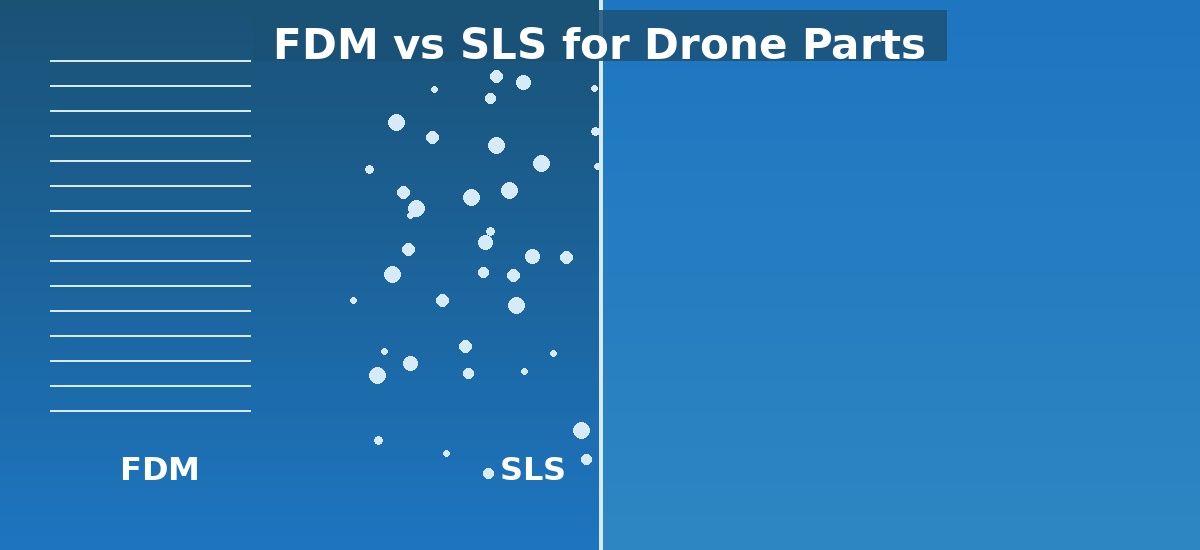
FDM melts thermoplastic filament and extrudes it layer by layer. Most accessible 3D printing method—affordable printers, wide material range. Parts are anisotropic: much weaker across layers than along the layer direction.
SLS (Selective Laser Sintering)
SLS uses a laser to selectively fuse powder particles (usually nylon PA12). No support structures needed. Fully dense, isotropic parts with excellent impact resistance. Clean on all sides.
SLA (Stereolithography)
SLA uses UV light to cure liquid photopolymer resin. Smoothest surface finish and tightest tolerances. Downside: resin parts are brittle and can degrade under UV.
MJF (Multi Jet Fusion)
HP’s MJF fuses powder using heating agents and infrared energy. Excellent surface finish, tight tolerances, true isotropic strength, and superior batch-to-batch consistency. Production-grade quality.
Head-to-Head Comparison
FDM for Drone Parts: When It Makes Sense
Choose FDM if: You’re prototyping, need specific materials (carbon-fiber nylon, TPU), printing large parts where volume drives cost, or have in-house printers.
FDM parts are affordable at scale. A drone frame printed in carbon-filled nylon costs $5–$20 in material. Turnaround is 24 hours. The material range is unmatched.
Critical limitation: Parts are anisotropic—layers bond through extrusion, not fusion. Tensile strength along XY can be 2–3x higher than Z direction. Supports leave rough marks requiring post-processing.
Pro tip: Orient parts so primary load runs parallel to layers. A motor mount printed with length along Z-axis will fail under side-load. Rotate 90° and tensile strength jumps 2–3x.
SLS for Drone Parts: When It Makes Sense
Choose SLS if: You need functional end-use parts, complex internal channels or lattice structures, isotropic strength, or clean surfaces on all sides.
PA12 nylon sintered by laser fuses uniformly—no anisotropy penalty. Impact resistance is excellent. SLS unlocks lattice structures, complex internal channels, and topology-optimized geometries impossible with FDM.
Real-world example: Framework Robotics shifted from FDM to SLS because FDM parts delaminated under vibration. SLS improved durability from 50 flight hours to 200+.
SLS costs 3–5x more than FDM per part, but a $30 SLS part lasting 500 flights beats a $5 FDM part failing after 50.
SLA for Drone Parts: When It Makes Sense
Choose SLA if: Surface finish and tight tolerances are critical—aerodynamic fairings, camera housings (±0.1 mm tolerance), wind-tunnel models.
SLA delivers 0.1 mm minimum feature size—5x finer than FDM. Parts cure to optical clarity or custom colors.
Limitation: Resin is more brittle than nylon. UV degradation is real—parts become brittle over months in sunlight. Not suitable for load-bearing structures.
MJF for Drone Parts: When It Makes Sense
Choose MJF if: You’re producing 10–1,000+ identical parts and need batch consistency, complex geometry, and isotropic strength with smoother finish than SLS.
A single HP MJF printer can produce 7,000+ small quadcopter frames per month. UAV Works’ HUNTER drone is approximately 96% 3D-printed using MJF.
MJF parts have 5–10% higher elongation at break compared to SLS, making them more impact-resistant. Cost per part drops significantly at volume: single part $20–$30, 100 parts averages $8–$15 each.
Decision Matrix
Real-World Performance: FDM vs SLS in Flight
Test case: Racing drone frame, 250 mm quadcopter
FDM is 80% cheaper, but SLS and MJF deliver 5x durability. For competitive racing or production UAVs, the durability multiplier justifies the cost premium.
Conclusion: FDM vs SLS for Drone Parts
FDM vs SLS for drone parts isn’t binary—it’s a decision based on stage and constraints. Prototyping? FDM wins on speed and cost. Functional durability? SLS or MJF. Production scale? MJF dominates. Budget-first? FDM, with careful design.
Modern drone design increasingly defaults to SLS or MJF for end-use parts and FDM for rapid prototyping. Isotropic strength and support-free geometry are too valuable to abandon.
Not sure which technology is right for your drone design? Upload your CAD file to 3D On Demand, and our engineering team will recommend the optimal technology and material for your application.


Apr 8, 2026
Design during the day, print overnight, test the next morning. A practical workflow for running rapid prototyping iterations at one per day.


Apr 8, 2026
A structured checklist for testing 3D printed prototypes: visual inspection, fit testing, functional validation, and user testing. Get the most out of every iteration.
.webp)





Copyright © 3D On Demand